"Who actually decides here?" – that single question often determines a project's success or failure more than any project plan does. Project governance gives a clear answer: it is the framework of roles, decision rights and control points that connects projects to business objectives. We show which building blocks it comprises – and how scattered tools become one shared governance framework.
What is project governance?
Project governance is the system of roles, decision rights, processes and control structures that keeps a project aligned with business objectives across its entire life cycle. It answers three core questions: who makes which decisions? Under what rules? And how is compliance monitored? The international standard ISO 21505:2017 addresses exactly this level – governing bodies, sponsors, steering committees and the project management office (PMO).
The distinction from management matters: project management runs the project operationally within the framework; governance sets that framework and monitors it. Good governance is not an end in itself, nor extra bureaucracy – it creates clarity, pace and traceability.
What does it involve? The six building blocks
Across the common frameworks – from PMI to ISO 21505 – six building blocks stand out:
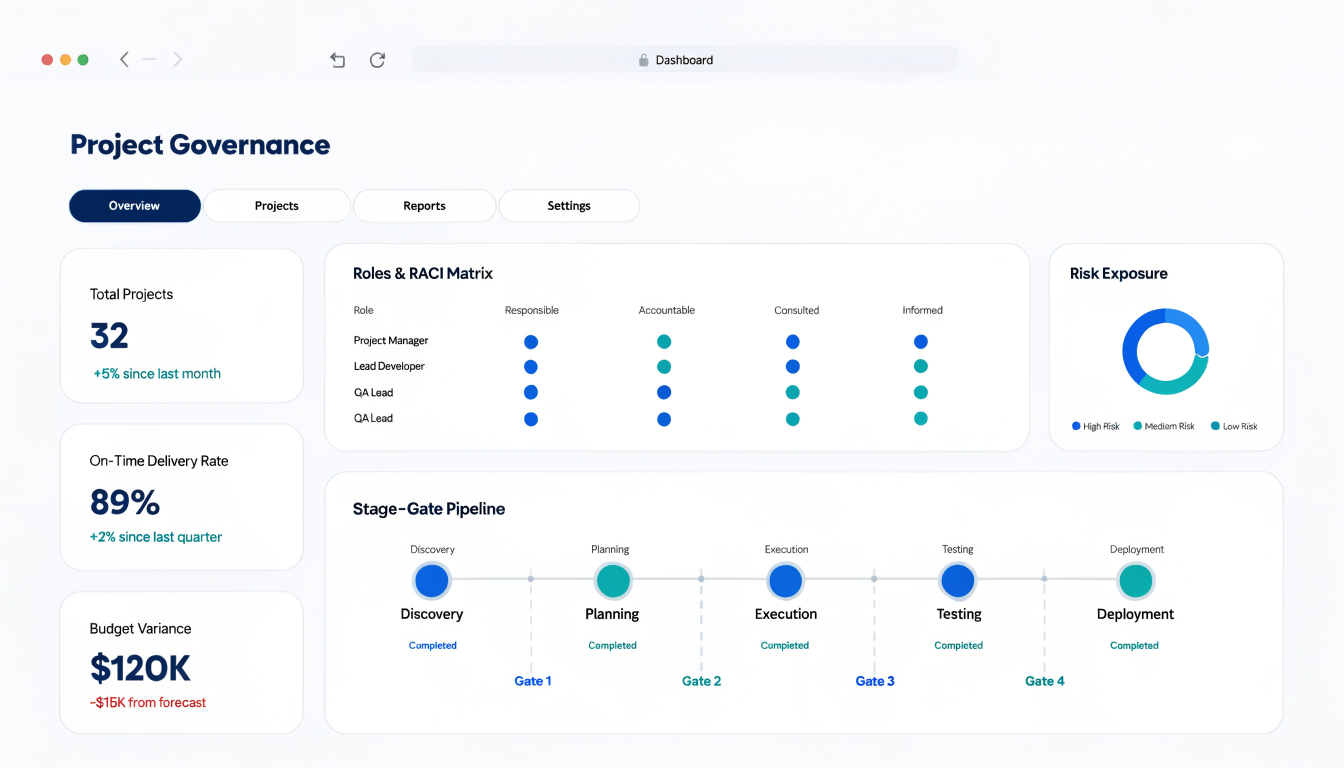
1. Roles and responsibilities. Clearly defined roles are the foundation: the sponsor (usually an executive) secures strategic alignment and resources, the steering committee takes higher-level decisions, the project manager owns delivery, and the PMO provides methods, standards and comparability. Models such as RACI help assign accountability unambiguously.
2. Decision rights and escalation. Governance defines who may decide what and up to which threshold – and what happens once a threshold is exceeded. Without defined escalation paths, issues either stall or land at the wrong level.
3. Phase and stage gates. At defined control points ("gates"), a project is assessed against visible criteria – strategic fit, business case, risk – and then deliberately continued, adjusted or stopped. That is what turns stage-gate decisions into genuine turning points rather than formalities – provided the criteria for each gate are agreed in advance and not improvised in the meeting itself.
4. Reporting and transparency. A binding reporting cadence with consistent status, metrics and milestones creates a shared factual basis. Decisions need data, not gut feel.
5. Risk and quality management. Risks, issues and quality assurance belong in a structure that captures, assesses and escalates them to the right place – continuously, not only at project close.
6. Stakeholder engagement. Governance defines who is involved and informed, when and how. That keeps expectations aligned and avoids surprises in the steering committee.
Project governance in practice: one framework across tools
In reality, governance rarely fails on the concept – it fails on tool sprawl. Software development works in Jira and Confluence on Atlassian Cloud, business departments use Planner, and project requests and resource plans sit in Excel files and SharePoint lists. Every team sensibly works with what fits it – but the layer above is missing: a single picture of status, prioritization, resources and risks.
That is precisely the layer PPM solutions such as Altus PPM and Projectum xPM provide. As model-driven apps on Microsoft Dataverse, they consolidate data from the operational tools – including the Jira integration – into a shared portfolio picture and lay common standards for stage gates, reporting and resource management on top. Scattered point solutions become end-to-end project governance across all departments – without taking away the tools teams are used to.
Conclusion
Project governance is not a bureaucratic surcharge but the answer to the question of who decides what, with which mandate. Define roles, decision rights, gates, reporting, risk and stakeholders cleanly – and anchor that framework technically in an integrated PPM tool – and you gain control, pace and reliability.
FAQ: Common questions about project governance
What is project governance?
Project governance is the system of roles, decision rights, processes and control structures that keeps a project aligned with business objectives across its entire life cycle. It sets the framework within which project management operates.
What does project governance involve?
Six building blocks: clearly defined roles and responsibilities (sponsor, steering committee, project manager, PMO), decision rights and escalation paths, phase or stage gates, reporting and transparency, risk and quality management, and stakeholder engagement.
What is the difference between project governance and project management?
Project management runs the project operationally within the given framework. Project governance sets that framework, defines decision rights and control points, and monitors compliance with them.
How Holert supports you in building your project governance
In practice, governance rarely fails on the description. Roles, gates and reporting lines can be defined in a workshop – and then sit in a document nobody opens. The framework only becomes binding once decision rights, gate criteria and status reports are configured in the tool that actually runs the projects. It is exactly at this translation from governance structure into the tool landscape that the effort stalls in most PMOs.
Holert has been supporting that step for more than 25 years – methodologically based on PMI and ISO 21505, technically on Microsoft Dataverse with Altus PPM or Projectum xPM and with an integration to Atlassian Jira. We translate your role model into security roles and approval workflows, your stage gates into a configured project life cycle, and your reporting into Power BI. At a fixed price, that runs through Smart Start – PPM implementation at a fixed price. Our customers include KUKA, Rohde & Schwarz, LAPP and KWS; project examples are on our PMO and project management references page.
Would you like governance not just on paper, but lived across your tool landscape? Holert supports PMO and IT teams in building it – from the governance structure through to implementation with Altus PPM or Projectum xPM on Dataverse and the integration with Atlassian. Get in touch via our contact form.
 Renke Holert
 Renke Holert : Jun 7, 2026, 12:24:11 PM