For years, PMOs running their project portfolio on the Microsoft Power Platform had a comfortable rhythm: twice a year a release wave landed, someone read the release plan, and the team spent an afternoon deciding what to adopt. That rhythm is being retired. From September 2026, Dynamics 365, Power Platform and Dataverse capabilities publish continuously to the AI at Work roadmap, and by 15 November 2026 the Release Planner disappears. Which makes one environment setting most PMOs have never looked at suddenly important: the release channel.
Executive summary for PMO leads: Microsoft is replacing twice-yearly release waves with continuous roadmap publishing. For PMOs running Altus PPM or Projectum xPM on Dataverse, the release channel on the environment — Auto, Monthly or Semi-annual — is now the main lever over how fast end-user-visible change reaches project managers. AI helps at the intake end, filtering and summarising the feed; it does not make the adoption decision.
TL;DR
- No release wave 2 announcement in September 2026. New capabilities appear on the roadmap as soon as they are committed.
- Release Planner retires by 15 November 2026; items with a preview or GA date of 1 June 2026 or later move to the AI at Work roadmap.
- Check your release channel. Auto is treated as Monthly on Power Platform environments, and new model-driven apps default to Monthly.
- Semi-annual is still available if your organisation needs testing and training lead time — but it is now a deliberate choice, not the default.
- The roadmap is queryable through Microsoft's Release Communications MCP server, which is where AI earns its keep.
Why this matters more to the PMO than to IT
IT administrators already work with continuous change; Message Center has trained them for it. PMOs have not. If your portfolio runs on Dataverse — through Altus PPM, Projectum xPM or a custom model-driven Power App — the platform underneath your governance model now changes on its own schedule, not on a calendar you can plan against.
The practical risk is not missing a feature. It is that changes to how projects are approved, resourced and reported arrive unannounced in an environment your PMO owns but does not administer. A new view, form behaviour or agent capability that changes what a project manager sees is a governance event, whether or not anyone treated it as one. Microsoft's advice in the announcement is blunt: set your own review rhythm, monthly or quarterly.
The setting most PMOs have never opened
The release channel is configured in the Power Platform admin center under Environments > Settings > Behavior, and it decides when generally available, end-user-impacting features are switched on for your users.
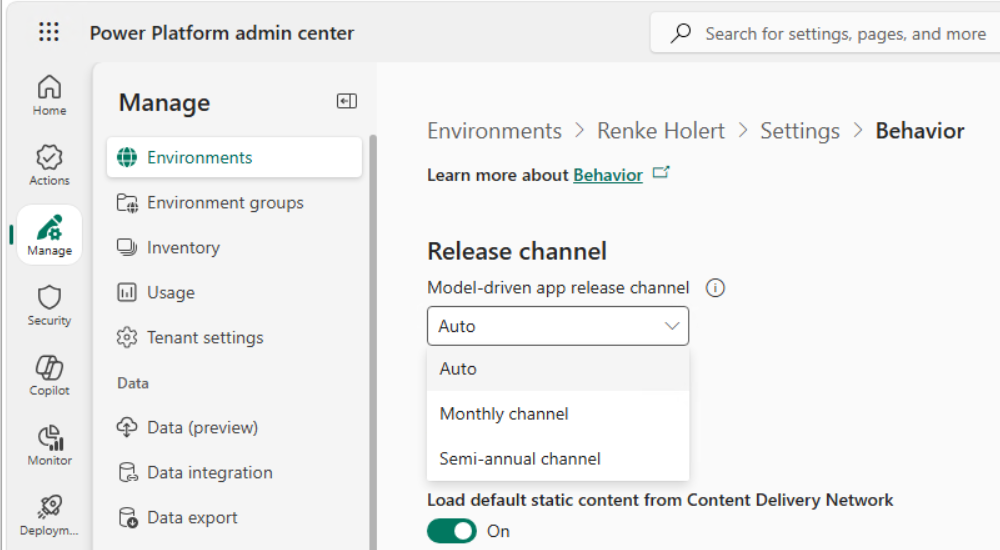
Two details catch most PMOs out. First, the semi-annual channel is the release wave cadence — the one Microsoft is retiring as a communication model. Second, since the 2024 release wave 1 change, Power Platform environments treat Auto as Monthly, and newly created model-driven apps default to Monthly. If nobody ever touched the setting, your PPM environment is most likely already on a monthly cadence.
Monthly or semi-annual: which fits a PMO environment?
| Aspect | Monthly channel | Semi-annual channel |
|---|
| Frequency | Once a month, with the first release of the month | Twice a year, early April and early October |
| Notice period | Four-week preview window to validate against your customisations | Release wave documentation months in advance |
| Change size | Twelve small releases | Two large releases |
| Fits a PMO that | Has a standing monthly review and few heavy customisations | Needs training and regression testing before project managers see change |
| Effort profile | Small and continuous | Concentrated, twice a year |
Neither is the right answer for everyone. The wrong answer is not knowing which one you are on. Security fixes and changes that do not affect end users continue to ship weekly either way.
Three places where AI earns its keep in this loop
Query the roadmap instead of reading it. The roadmap is machine-readable through the Microsoft Release Communications MCP server, which exposes tools such as get_recent_roadmaps to MCP-compatible AI clients and refreshes daily. A PMO analyst can ask a plain question — “which Dataverse items rolling out this quarter touch security roles or scheduling?” — and get a short list. The review meeting then starts from ten relevant items instead of two hundred irrelevant ones.
Turn roadmap items into portfolio demand. Most PMOs have an intake process for business demand and none at all for platform demand. An AI-assisted triage step can classify each relevant item — no action, watch, or evaluate — and draft the matching backlog entry in Altus PPM, Projectum xPM or Jira, naming the affected process. Platform change becomes visible work with an owner, instead of an interruption three sprints later.
Let AI draft the brief, never the decision. Summarising what a capability does, which environments it affects and when it lands is work a Microsoft 365 Copilot or Copilot Studio agent handles well. Deciding whether to adopt it is not. The useful split: the agent produces a one-page change brief, a named person signs it off, and the decision is recorded against the environment — which is where Power Platform governance in the Admin Center comes in.
Where PMOs need help: turning a feed into a decision process
Reading a setting takes a minute and subscribing to an RSS feed takes five. What does not happen by itself is everything after that: deciding who in the PMO owns platform change, how a roadmap item becomes a governed decision, where that decision is recorded, and how it reaches the project managers whose working day it changes. In practice most PMOs discover the gap only when a capability lands mid-quarter and nobody can say who approved it — and the answer is usually that the environment was on Auto and nobody had ever been asked.
Closing that gap is our core business: designing and implementing PMO and VMO operating models on Microsoft and Atlassian technology, grounded in PMI and SAFe, and building change intake into the PPM platform itself — Altus PPM, Projectum xPM, Microsoft Planner and Project, or Jira. Where the environment itself needs looking after, our Power Apps Governance managed service covers it. We have been implementing and optimising project and portfolio management solutions for over 25 years, for organisations including KUKA, Rohde & Schwarz, Miele/Steelco-Belimed, LAPP and Amer Sports; further customer references are on our website.
Frequently asked questions
Will there be a release wave 2 announcement in September 2026?
No. Microsoft has confirmed that new capabilities are disclosed on the AI at Work roadmap as they are committed, rather than grouped into a twice-yearly wave.
Does retiring release waves change my release channel?
No. The change is to how Microsoft communicates upcoming capabilities. The semi-annual channel remains available as a delivery cadence, and existing release schedules continue.
How do I find out which channel our PPM environment is on?
In the Power Platform admin center under Environments, select the environment, then Settings and Behavior. Note that an app-level setting other than Auto overrides the environment setting, and a user-level override beats both.
How often should a PMO review the roadmap?
Monthly if your organisation adopts new capabilities quickly, quarterly if it does not. The decisive factor is not frequency but whether the review has a named owner and produces a recorded decision.
Does this affect Altus PPM or Projectum xPM directly?
Not the products themselves. It affects the Dataverse and Power Platform layer they run on, which is where most governance-relevant change originates.
Set your cadence before November
The Release Planner retires on 15 November 2026. Before then is a good moment to check which release channel your PPM environment is actually on, and to decide deliberately how your PMO will notice and govern platform change from that point — including where AI belongs in that loop. Our PMO AI Power Day is a one-day working session that produces exactly that: a shortlist of AI use cases for your PMO, assessed against your data and governance reality, with a decision on what to pilot first.
 Renke Holert
 Renke Holert : Aug 12, 2026, 7:46:30 AM